WISPIT
Wide Separation Planets in Time
Header image: WiSPIT logo by C. Ginski
Encouraged by our success with the YSES survey, we expanded our parameter search to include all young stars across the sky visible from the VLT, and ended up with a sample of 180 stars covering ages from 2 Myr up to 20 Myr.
The Wide Separation Planets in Time (WISPIT) survey is being carried out over several periods since 2022, and to date (Jen 2026) has produced two exoplanet systems.
WISPIT 1b and 1c
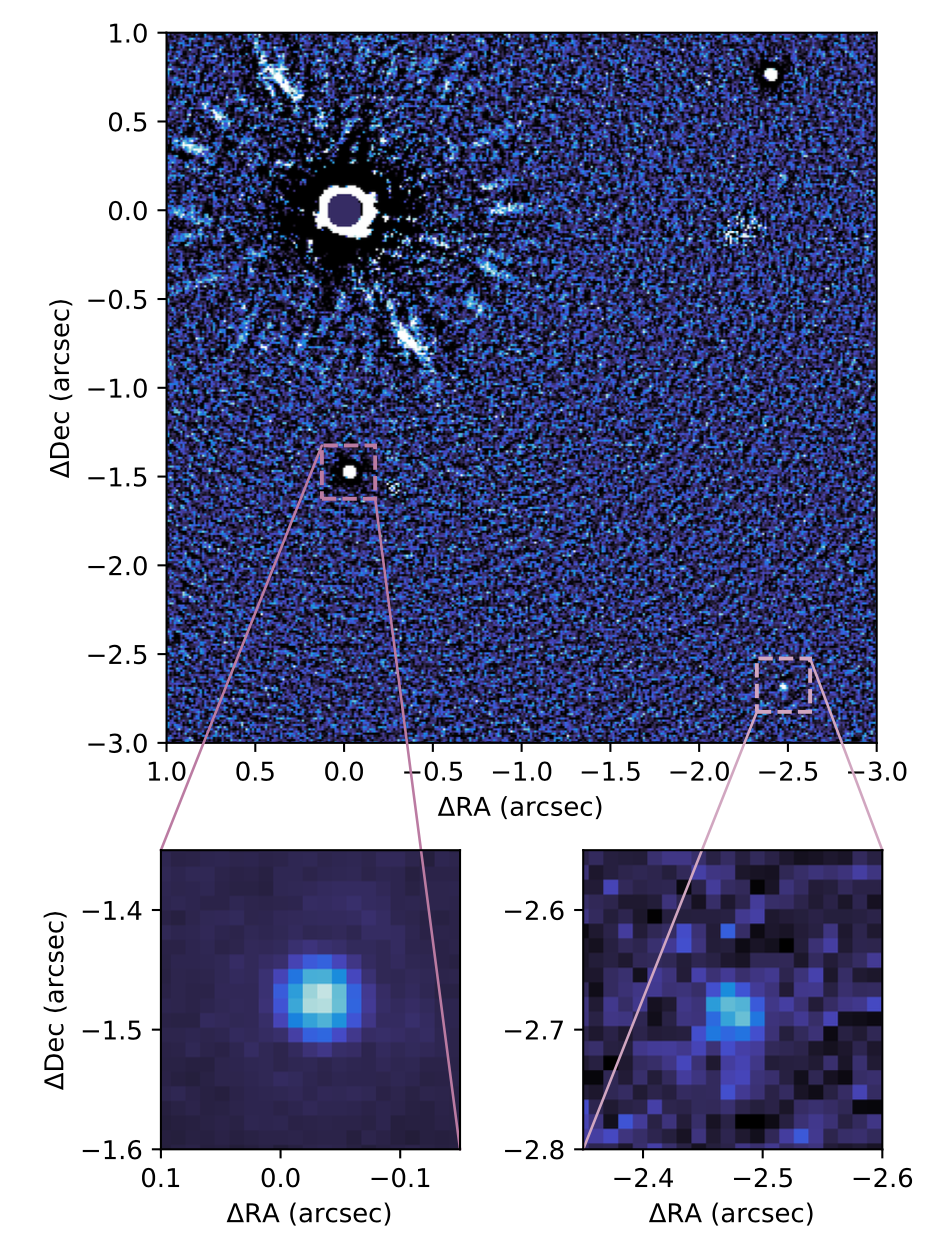
WISPIT 1 is a stellar binary with a primary star of around one solar mass, with two comoving companions identified as gas giant exoplanets (van Capelleveen et al., 2025). These companions have photometric masses of 10 and 5 Jupiter masses, orbiting at projected distances of 338 and 840 au respectively.


WISPIT 2
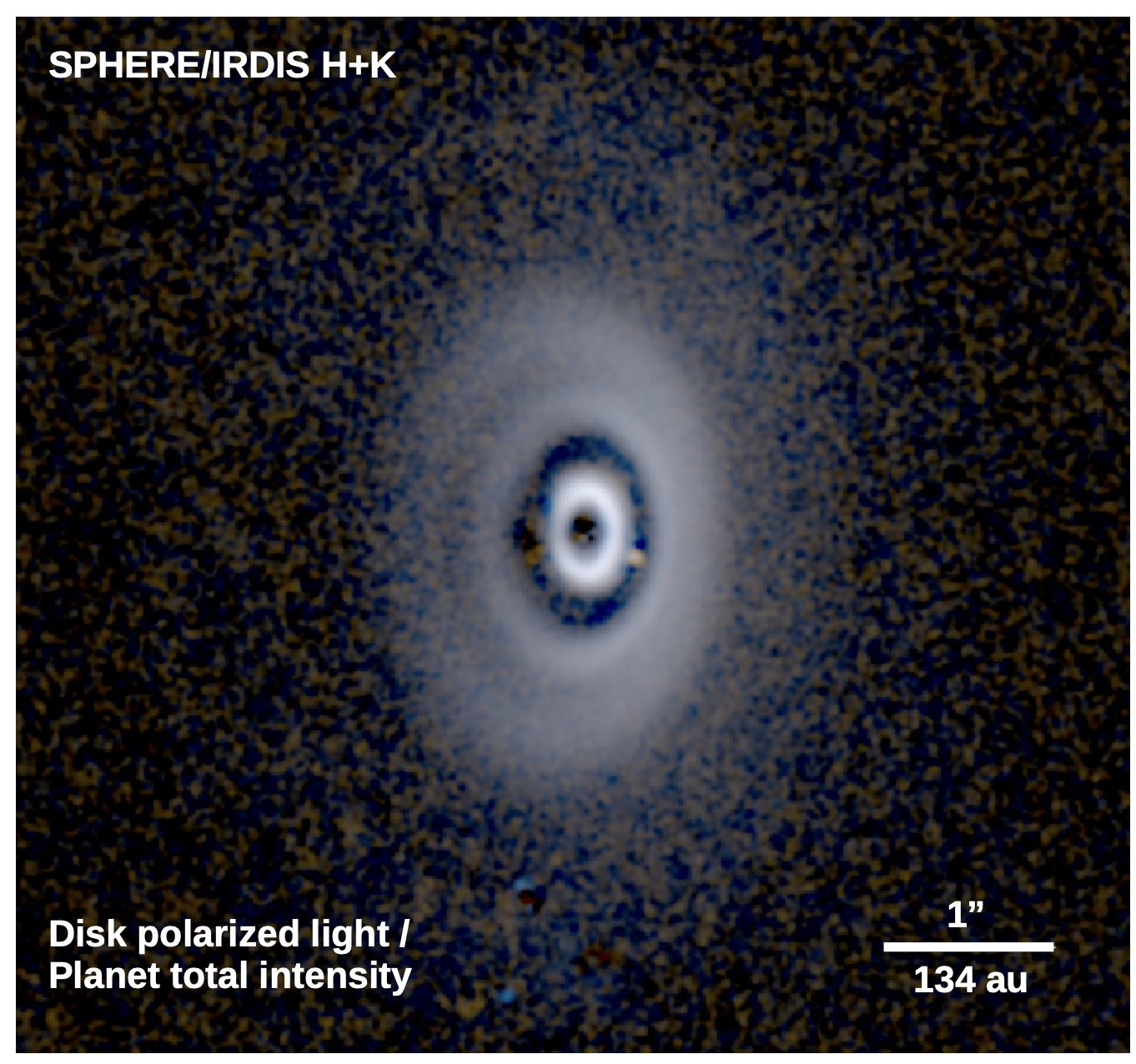
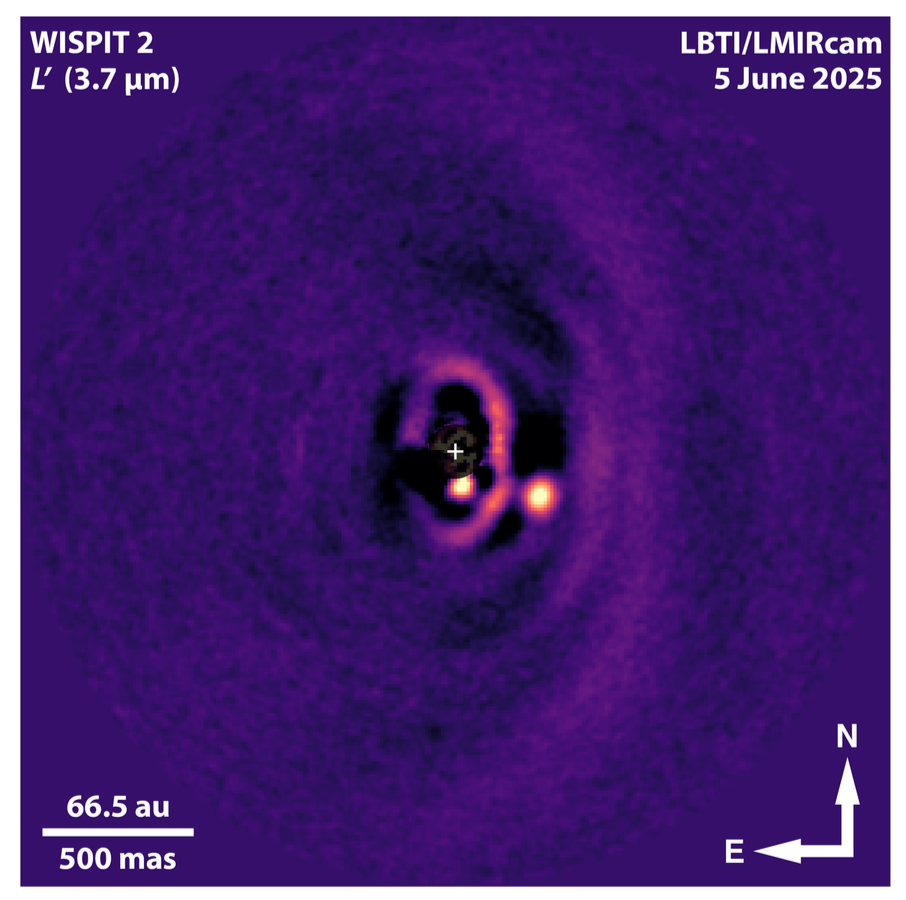
We detected a spectacular circumstellar disk which has several cleared rings within it. The widest ring has a protoplanet of about 5 Jupiter masses (van Capelleveen et al., 2025), and is detected as a point source in the optical Hydrogen alpha line indicating that is is undergoing acitve accretion within this cavity (Close et al., 2025).


The two papers detail the orbital dynamics of the planet, which is at about 56 au from the central star with a photometric mass of 5 Jupiter masses. Orbital motion is seen over two years of observations, confirming it is comoving with the star, and the astrometry is consistent with Keplerian orbital motion within the dust gap opened up by the planet.
Imaging from Hydrogen alpha in the optical through to L band at 3.6 microns confirm that the planet is accreting gas, and has a thermal spectral energy distribution with a young planet consistent with the age of the disk and star.
Since the star is close to the celestial equator of the Earth, it is visible from all the large observatories. The width of the gap is an important test of planet formation theories. Multiple follow up observations are now underway and are expected to appear throughout 2026.